Trading journal: free template and completed example
A trading journal records what you planned, what you actually did and what happened. Keep decision quality and financial results in separate fields so a winning mistake does not become a new rule.
Completed trading journal example
This hypothetical paper trade shows how to record a loss when the trader followed the written rules. Prices and fees are in US dollars.
- Date, time and timezone
- October 20, 2026, 14:05 UTC.
- Instrument / market
- Fictional Share A in a paper-trading exercise.
- System version and setup
- Version 1.2. Price returned to the recorded entry level after the opening range.
- Planned entry, size and exit
- Ten simulated shares at 50.00. Planned exit if the price fell to 49.50.
- Risk limits and session status
- The written size limit was ten shares. The session was open.
- Evidence and invalidation conditions
- The simulated quote returned to 50.00. A fall to 49.50 would invalidate the setup.
- Readiness and checklist result
- I checked the instrument, size and session status before entering.
- Actual action and fills / no-trade reason
- Entered at 50.00. The simulated exit filled at 49.48 at 14:18 UTC.
- Fees, financing and slippage
- Exit slippage was 0.02 per share. The simulation charged 1.00 in total fees and no financing.
- Outcome and measurement period
- From entry to exit, the ten shares lost 5.20 before fees and 6.20 after fees.
- Rule adherence and any override
- I placed the planned exit and left it in place. No override.
- Review: what to investigate next
- Compare planned and simulated exit prices across the next weekly batch of entries.
Use this format for my own entry
Download the journal workbook (.xlsx) to track several entries in one file. Open it in Numbers, Excel, or Google Sheets and add one row per decision below the headings.
Fill in a journal entry
Blank journal template
Download the blank journal template (.txt). Copy it into your preferred notes app or print this page. Use a new entry for each decision and retain the system version so different rules are not mixed together.
No-trade journal example after a loss
Hypothetical entry, recorded at 14:25 UTC after a losing paper trade.
- Risk limits and session status
- My written plan ends new entries for the day when the session loss limit is reached. My last exit brought me to that limit.
- Readiness and checklist result
- I wanted to double the next order to recover the loss. I marked the hard-stop question “Yes.”
- Actual action and fills / no-trade reason
- I placed no order. The session stop was already in effect.
- Review: what to investigate next
- At the weekly review, check whether I recorded the stop immediately after the exit. Reassess eligibility at the next scheduled session.
What to record before and after
Before: timestamp, instrument, rule version, entry and exit conditions, intended exposure, evidence, uncertainty and checklist result. Capture these before knowing the outcome.
After: actual fills, position changes, costs, outcome, rule adherence and any overrides. Do not rewrite the original reasoning; append a dated correction when needed.
Fees are not the only cost. Record spread, slippage and financing where applicable. Keep a consistent method so your results remain comparable.
A weekly review you can repeat
- Check completeness. Reconcile entries with actual activity, including winners and decisions not to trade.
- Separate results from process. Review costs and outcomes alongside adherence, without treating either as proof of the other.
- Group comparable observations. Compare the same setup and system version under similar conditions.
- Investigate one issue. Choose a concrete question, such as whether an execution assumption is realistic.
- Version changes. Document the evidence and test plan before adopting a new rule.
A small sample may suggest a question; it does not establish a reliable improvement. Avoid redesigning a system after each loss or claiming statistical significance from a week of trades.
Weekly trading journal review example
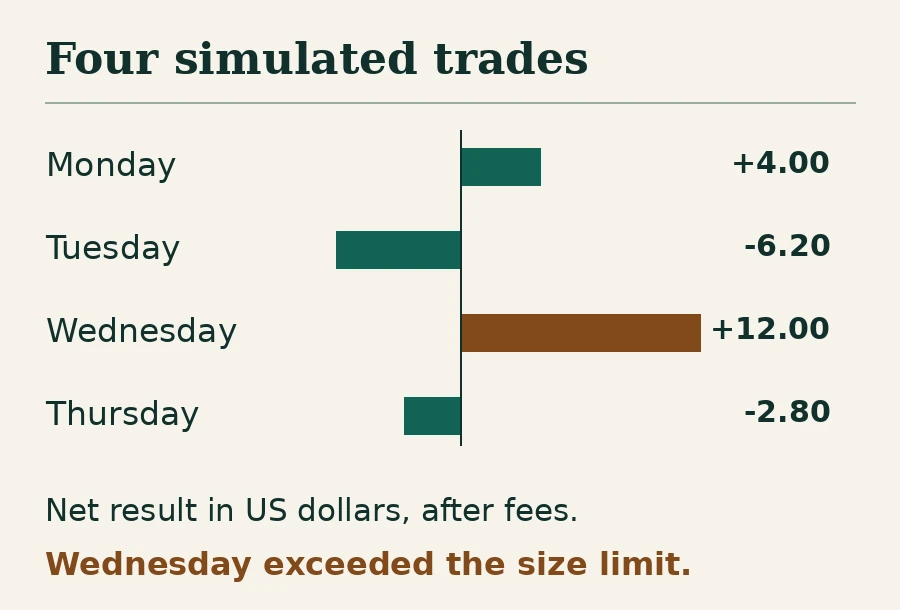
Imagine reviewing the week of October 19–23, 2026. All five decisions used version 1.2 of the same paper-trading plan. Match the journal to the four closed paper trades, then include Friday’s decision to skip. The dollar amounts are net of simulated fees.
| Day | Journal entry | Net result | Rule check |
|---|---|---|---|
| Mon | Entered at the planned size. | +$4.00 | Followed |
| Tue | Exited at 49.48 as recorded in the example above. | −$6.20 | Followed |
| Wed | Entered 20 simulated shares against a written limit of 10. | +$12.00 | Exceeded size limit |
| Thu | Exited when the setup was invalidated. | −$2.80 | Followed |
| Fri | Skipped the entry when the required quote was unavailable. | No fill | Followed |
What I wrote on Friday
“My four trades added up to a $7 gain. I followed the plan on four of five decisions, including Friday’s skip. My biggest gain came on Wednesday, when I doubled the allowed size. The dollar total alone would have hidden the one decision I want to investigate.”
Question for next week. When did Wednesday’s quantity change from 10 to 20? For the next five order tickets, record the planned quantity and the quantity shown immediately before submission. Compare the two at Friday’s review.
Research context
Barber and Odean’s study of individual investors examined US brokerage accounts from the 1990s and found that frequent trading was associated with weaker net performance in that sample. It highlights the importance of costs; it does not prove that this journal template improves returns.
Sources and scope
- FINRA: Day-Trading Risk Disclosure Statement — risks, transaction costs and execution limitations.
- SEC Investor.gov: Stop, Stop-Limit, and Trailing Stop Orders — why a stop price is not a guaranteed fill.
These US securities sources provide background, not rules for every market or jurisdiction. The checklist and review routines on this site are editorial tools, not validated predictors of returns.
Questions
Should I record only losing trades?
No. Include all trades and relevant no-trade decisions. Selective records can hide profitable rule violations and distort your review.
How often should I review it?
Record details while they are fresh, then use a scheduled review such as a weekly session. The appropriate evaluation period depends on the strategy and sample size.
Does the page save my entries?
No. Download or print an entry before leaving the page. There is no account or cloud journal storage.
Continue reading
Pre-trade checklist · Revenge trading · Rules vs discretion in trading