Pre-trade checklist: free template and worked example
A pre-trade checklist compares a proposed trade with your written system, risk boundaries and ability to execute the plan. It can help document a decision; it cannot establish that a strategy is profitable.
Use the form below, or print the page and complete the same checks by hand. Define your risk limits before the session, not while filling this in.
Interactive pre-trade checklist
How to interpret the result
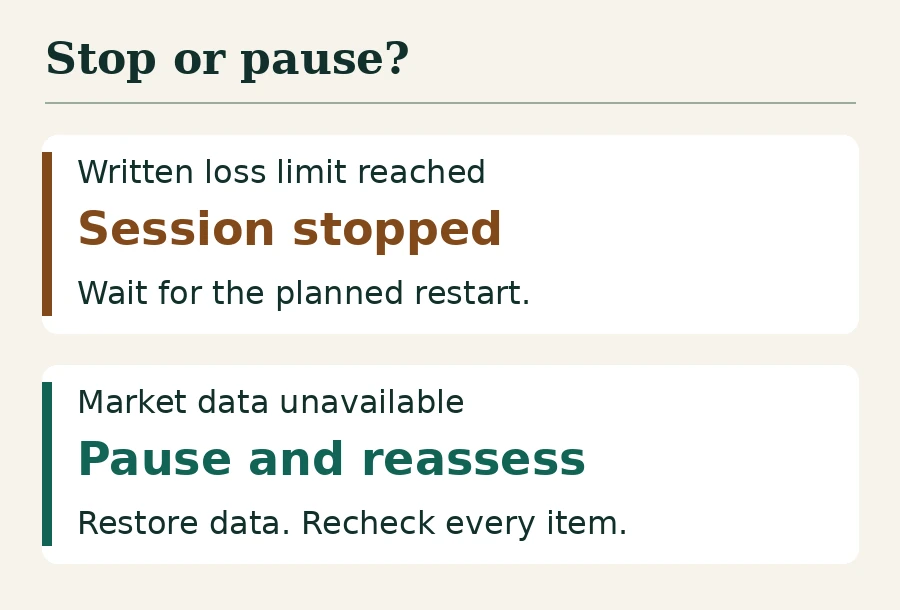
- Session stopped: a predefined hard limit has been reached. Do not use a short break or a better mood to reset it. Resume only under the restart conditions already written in your plan.
- Pause and reassess: a check fails, is uncertain or is unanswered. Record the reason. A pause is not permission to change an entry condition until a trade qualifies.
- Checks recorded as met: your answers meet this checklist. This does not verify market data, validate your strategy or instruct you to place an order.
Existing positions still need management under the original risk plan; stopping new entries does not mean abandoning open exposure.
Copyable and printable template
Download the free trading checklist (.txt). The print button also works with your browser’s Save as PDF option.
Date / time and timezone:
Instrument and setup:
System version:
Hard session stop reached? Yes / No / Unknown
Setup meets written conditions? Yes / No
Size, exit and exposure within rules? Yes / No
Market and execution conditions acceptable? Yes / No
Ready to follow the plan? Yes / No
Evidence / uncertainty:
Decision: session stopped / pause / checks met
Next action under the existing plan:
Worked example: a valid setup, a stopped session
Hypothetical example: a trader’s plan says no new entries once the session loss boundary is reached. Another setup meets the entry criteria, and the trader now feels calm.
The hard-stop answer is still “Yes.” The checklist result remains Session stopped, even if every other answer is positive. The record should name the rule and its predefined restart condition. Calmness cannot reset the boundary.
Contrast this with a temporary platform-data problem before any stop is reached. The execution check fails, so the decision is “Pause and reassess.” After reliable data returns, the trader must check every condition again; the original setup may no longer exist.
Keep market signals separate from feelings
A market signal is evidence defined by your strategy. A feeling of urgency or discomfort is a reason to examine your readiness, not evidence of the next price move. This site’s readiness check is a practical reflection prompt; no claim is made that a bodily sensation predicts returns.
Document predefined suspension rules separately from spontaneous overrides. A suspension rule belongs to the system and needs evaluation alongside it. An override changes the process and should be logged honestly.
Use the trading journal template to record the result, including decisions not to trade.
Sources and scope
- FINRA: Day-Trading Risk Disclosure Statement — risks, transaction costs and execution limitations.
- SEC Investor.gov: Stop, Stop-Limit, and Trailing Stop Orders — why a stop price is not a guaranteed fill.
These US securities sources provide background, not rules for every market or jurisdiction. The checklist and review routines on this site are editorial tools, not validated predictors of returns.
Questions
Does passing the checklist mean a trade is safe?
No. The form reports your answers. Trading can lose money even when all rules are followed.
Should I shorten the checklist to make it faster?
Keep the checks relevant, but do not remove risk or execution checks just to meet a time target. Resolve uncertainty before treating an item as passed.
Can I use this without JavaScript?
Yes. Read the questions, download the text template or print the page. The automatic status and decision-note export require JavaScript.
Continue reading
Trading journal · Revenge trading · Rules vs discretion in trading